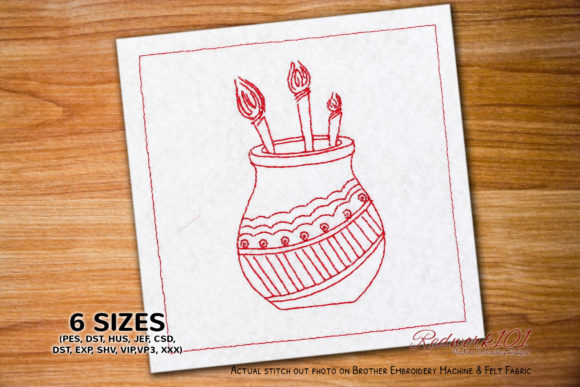
Painting Brush in Holder
A Redwork Embroidery Design That Speaks to Crafters—Before It Even Hits the Booth
As an embroidery designer who’s prepped over 200 craft fair booths—and shipped thousands of machine embroidery designs to Etsy sellers, boutique makers, and small shop owners—I opened Painting Brush in Holder with a quiet but immediate nod. This isn’t flashy or trendy. It’s warm, grounded, and quietly confident—a redwork embroidery design that feels like a nod between friends at a paint-splattered worktable. It reads as rustic-meets-refined: clean enough for modern farmhouse tea towels, detailed enough for embroidered patches, and expressive enough to carry personality on an apron pocket or tote bag design.
Where Painting Brush in Holder Shines Most—And Where It Needs Care
In my booth setup, I group products by function and visual rhythm: kitchen items on one shelf (tea towels, oven mitts, market bags), wearable pieces on a rack (aprons, caps, pouches), and giftable accents on a folded display (pillow covers, framed patches, small embroidered pouches). Painting Brush in Holder lands strongest in the kitchen and wearable zones.
- Tea towel embroidery: Perfect scale and balance. The brush sits upright in its holder with clear negative space—no crowding. On natural linen or oatmeal cotton, it reads instantly from three feet away. Redwork thread pops without screaming.
- Apron embroidery: Ideal for the chest pocket or lower left front panel. It adds charm without overwhelming the garment’s utility. Customers consistently pause here—especially fellow crafters who recognize the tool as both familiar and celebratory.
- Embroidered patch: Works beautifully as a 3–4" sew-on or iron-on. Clean lines hold up well when cut and finished. Great for bundling with art supply kits or gifting to beginner painters.
- Tote bag design: Best as a centered focal point on the front panel—not too large, not too small. Avoid placing near seams or gussets where distortion can blur detail.
- Caps and curved surfaces: Use caution. The brush handle and holder base have subtle tapering. Test stitch density and hoop size first—curved fabric pulls threads tighter, and fine redwork can lose definition if stabilizer isn’t matched to fabric texture.
What Makes This Design Sell—Beyond the Stitch
At a craft fair, attention is measured in seconds. Painting Brush in Holder wins because it’s immediately legible, emotionally resonant, and commercially versatile. It doesn’t need explanation. A painter sees their world. A knitter or ceramicist sees kinship. An Etsy seller sees cross-category appeal: art supplies, handmade gifts, studio decor.
It photographs cleanly for digital listings—no busy background needed. A simple white or muted sage backdrop lets the redwork sing. For printable mockups, it scales well across sizes: 2.5" for a patch, 5.5" for a pillow cover, 7" for a tote. And yes—it feels premium as a finished product. Not “cute” in a juvenile way, but thoughtful, like a small tribute to creative labor.
Production Notes Every Embroidery Designer Should Check
Redwork looks deceptively simple—but clarity depends on precision. Before cutting your first production run, do these six things:
- Test on scrap fabric matching your final product (e.g., terry cloth for towels, twill for caps, linen blend for pouches).
- Verify thread contrast—especially on dark or heathered fabrics. Redwork traditionally uses red thread on white, but if you’re using ecru thread on charcoal linen, test visibility at arm’s length.
- Review spacing and stitch density. Tight curves around the brush ferrule or holder lip may require reduced density or walk-stitch reinforcement—check the embroidery file for potential nesting or underlay gaps.
- Confirm hoop size compatibility. If your machine maxes at 4x4", ensure the design fits without scaling down so far that fine lines vanish.
- Match stabilizer to fabric texture. Lightweight cutaway for stable cottons; tear-away + topping for textured towels; cap-friendly adhesive + medium-weight cutaway for curved surfaces.
- Create at least one real mockup—not just a digital preview. Hold it up beside similar products in your booth lineup. Does it hold its own? Does it support your brand voice—whether that’s cozy, minimalist, or artisanal?
Careful-Use Notes: Protect Your Stitch Quality & Customer Trust
This design includes delicate line work—especially where the brush bristles meet the holder opening and along the tapered wood grain detail (if present in the file). Avoid shrinking it below 2.25". On thick or napped fabrics like terry or fleece, expect some softening of edges—consider simplifying or omitting ultra-fine elements in those versions. Tiny lettering isn’t mentioned in the description, so assume none—but always confirm before adding custom text. And remember: Painting Brush in Holder is described as redwork, meaning it relies on strong thread contrast and clean outlines—not fill-heavy motifs. That makes it forgiving for beginners, but unforgiving of poor stabilization.
Final Thought: Why This Belongs in Your Next Craft Fair Lineup
As a Sewing and Embroidery professional, I don’t stock filler designs. I choose pieces that reinforce my booth’s story, convert browsers into buyers, and feel authentic when stitched onto a handmade product. Painting Brush in Holder does all three. It supports community—speaking directly to makers while remaining accessible to gift buyers. It elevates everyday items without demanding attention. And it performs reliably across product types, from commercial embroidery runs to limited-edition digital embroidery file bundles.
If you’re an Etsy seller refreshing your shop, a Cricut crafter expanding into machine embroidery, or a boutique maker building cohesive design assets—this is more than a motif. It’s a quiet invitation to slow down, pick up a brush, and make something real. Just make sure you’ve verified licensing before selling finished products, tested on your target fabric, and held it up beside your best-selling item. Because in the end, the strongest craft fair product isn’t the flashiest—it’s the one that feels true.