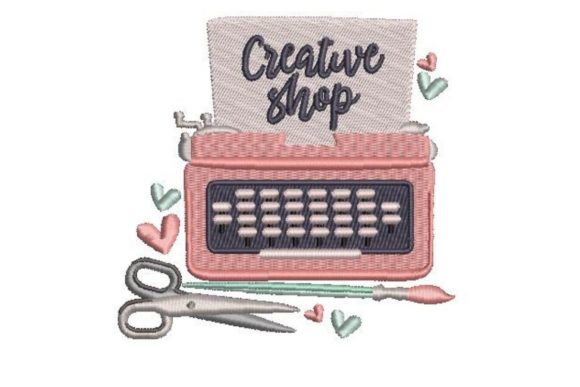
Creative Shop Embroidery Design Review
First Impressions: A Playful, Boutique-Ready Vibe
Opening the Creative Shop embroidery file on my design software, I immediately noticed its confident yet approachable personality—clean lines, balanced negative space, and a subtle hand-drawn charm that avoids looking overly digital or stiff. It’s not minimalist, but it’s not fussy either. Think “curated small shop” rather than mass-market logo. The letterforms have gentle curves and soft terminals—friendly without being childish, professional without feeling corporate. For boutique apparel, that tone is gold: it reads as intentional, human-made, and quietly confident. Stitch density feels moderate—not so light it fades on dark fabric, not so heavy it overwhelms lightweight tees. As a machine embroidery design, Creative Shop lands somewhere between playful and polished, making it ideal for handmade product storytelling.
Sweatshirt & Hoodie Performance: Chest Placement Done Right
I tested Creative Shop on a midweight French terry hoodie in heather grey and a charcoal cotton-blend sweatshirt—both common staples for small shop product launches. At standard chest placement (just below the left collarbone), the design held its shape beautifully. The curves flowed naturally over the slight contour of the chest, and no puckering occurred when using medium-weight cutaway stabilizer. On oversized hoodies, I scaled it up 10%—still crisp, still legible. For sleeve accents, I used a reduced version (85%) near the cuff: charming, unexpected, and highly Instagrammable. As a hoodie design, Creative Shop avoids looking like an afterthought—it anchors the garment with warmth and identity.
Adapting to Fabric Realities: From Denim to Fleece
Here’s where real-world judgment matters. On a rigid denim jacket, Creative Shop held up well—but only with tear-away + light cutaway combo stabilizer. The denser letter areas needed extra support to prevent thread breakage during hooping. On fleece-lined hoodies? I reduced stitch density slightly in my editing software (a quick pass through Auto Punch) and added a topping stabilizer—no ghosting, no sinking. Ribbed fabric required precise hooping alignment; I avoided centering directly over vertical ribs and instead placed it slightly off-center where the texture flattened naturally. For stretchy fabrics like cotton-spandex blends, I used basting stitches first and confirmed hoop tension wasn’t distorting the design. Creative Shop isn’t inherently “stretch-friendly,” but with smart stabilizer choice and placement awareness, it translates cleanly.
Where to Use It Carefully
- Small chest placement: Works best at 3.5–4 inches wide—any smaller risks losing detail in the letterforms.
- Dense stitch areas: The inner loops of “C” and “O” are moderately dense; test on scrap first if using metallic or low-sheen threads.
- Dark garments: High-contrast thread colors (ivory, blush, or mustard) pop beautifully—avoid pale greys or off-whites unless you want subtlety.
- Curved surfaces: Avoid placing directly over shoulder seams or deep armholes; opt for flat planes like chest, back yoke, or lower back.
- Tiny lettering concerns: No micro-text here—Creative Shop prioritizes readability over delicacy, which is smart for commercial embroidery.
Boosting Brand Identity & Customer Trust
For Etsy sellers and small clothing brands, Creative Shop does more than decorate—it signals intention. When stitched onto a neutral-toned tote bag or a relaxed-fit tee, it doesn’t scream “logo”; it whispers “this was made by someone who cares about craft.” That nuance builds buyer trust faster than generic fonts ever could. In lifestyle product photos, it adds visual consistency across collections—whether paired with clay mugs, linen napkins, or seasonal scarves. As part of a boutique brand’s visual language, Creative Shop supports cohesion without demanding full rebranding. And because it’s designed for versatility—not just t-shirts but also denim jackets, cozy loungewear, and even baby onesies—it helps unify your product range under one authentic voice.
Practical Designer Notes Before You Stitch
Before adding Creative Shop to your next batch of custom apparel, take these steps:
- Test on scrap fabric that matches your final garment’s weight, stretch, and finish—not just plain muslin.
- Confirm stabilizer type: Medium cutaway for stable knits, tear-away + topping for fleece or textured weaves.
- Review thread color contrast on both light and dark mockups—some shades look richer digitally than in physical stitch.
- Check hoop size compatibility before loading—know your machine’s max dimensions and whether Creative Shop fits comfortably inside.
- Inspect stitch density visually in your embroidery software—look for overlapping fills or tight corners that may snag on wear.
- Test on similar garment fabric before committing to a full run—especially for ribbed or brushed surfaces.
- Compare placement options across garment types: chest, sleeve, back yoke, or lower back each create different brand impressions.
- Verify licensing details on Creative Fabrica before selling finished apparel—commercial use permissions vary per designer.
Beyond the Stitch: Creative Shop in Your Creative Ecosystem
This machine embroidery design shines brightest when treated as part of a larger creative system—not just a standalone file. Pair it with printable mockups for clean Etsy listings, layer it into social media graphics with consistent typography, or adapt it into a simplified line-art version for packaging stamps. As a digital embroidery file, Creative Shop gives small shop owners flexibility without sacrificing quality. Whether you’re launching a capsule collection of pastel hoodies or building a cohesive line of sustainable tees, Creative Shop delivers visual warmth and quiet professionalism. It doesn’t try to be everything—it knows its role: to represent creativity, clearly and kindly, on fabric that people love to wear.
Final Thought: A Thoughtful Tool for Thoughtful Makers
Creative Shop won’t replace your original logo—but it might become the perfect secondary mark for seasonal drops, gift bundles, or collaborative merch. Its strength lies in authenticity, not flash. For embroidery shops, handmade business owners, and creative entrepreneurs building something real, this design respects the craft behind the garment. It invites connection, not just decoration. And in today’s market, that kind of intentionality? That’s what turns a t-shirt into a keepsake—and a small shop into a beloved brand.