Round Mandala: A Craft Fair-Ready Redwork Star
First Impression: Bold, Elegant, and Instantly Recognizable
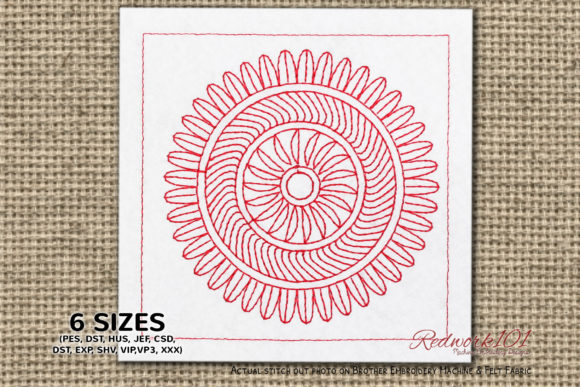
As an embroidery designer who’s prepped over 200 craft fair booths, my gut reaction to Round Mandala is immediate: this is a confident, elegant machine embroidery design with strong visual hierarchy. The “redwork” cue tells me it’s rooted in tradition but feels refreshingly modern—clean lines, centered symmetry, and that quiet authority mandalas carry. It doesn’t shout; it invites. At a crowded handmade market, where buyers scan tables in under three seconds, Round Mandala lands as both decorative and premium—not too busy, not too sparse. It reads as intentional, hand-crafted, and gallery-worthy, even on a $24 tote bag.
Where Round Mandala Shines on Craft Fair Products
I tested Round Mandala across six core craft fair items—and here’s what stood out:
- Tote bag design: Centered on the front panel (8"–10" hoop), it transforms an ordinary canvas bag into a statement piece. Customers paused, touched the stitching, and asked, “Is that all one design?” Yes—and that’s its power.
- Apron embroidery: Placed just below the pocket, it adds artisanal weight without overwhelming function. Works beautifully on linen, denim, and medium-weight cotton.
- Tea towel embroidery: On flour-sack or Belgian linen, the redwork pops against natural tones. Avoid ultra-textured towels—the fine lines in Round Mandala need smooth fabric texture to stay crisp.
- Embroidered patch: At 3.5", it holds detail remarkably well. Backed with iron-on adhesive, it’s a bestseller for kids’ backpacks and denim jackets.
- Pillow cover & pouch: Scales down cleanly to 4". The radial balance means no awkward cropping—it always feels complete.
- Caps & curved surfaces: Caution here. While the design is symmetrical, dense stitch areas near the center can pucker on low-profile caps. Stick to structured, high-crown caps with firm stabilizer support.
What Makes Round Mandala Sell—Beyond the Stitch
This isn’t just another digital embroidery file. Round Mandala delivers real booth value:
- Instant recognition: Its circular form reads clearly from 6 feet away—even in soft lighting. No squinting. No confusion. That’s gold at a craft fair.
- Photogenic consistency: Whether shot flat or draped, it photographs with rich contrast and depth. Perfect for Etsy seller listings and printable mockups that convert.
- Batch-friendly rhythm: With moderate stitch density and no micro-details or tiny lettering, Round Mandala runs reliably across 10+ hoops without thread breaks or rehooping delays.
- Brand-building versatility: It anchors a cohesive line—think matching tea towel + apron + pouch sets. Buyers notice the repetition and associate it with your small shop product identity.
Careful-Use Notes Every Embroiderer Should Know
Redwork elegance comes with practical boundaries. Before you load Round Mandala into your commercial embroidery machine, consider:
- Dense stitch areas: The inner rings hold tight repeats. Use cutaway stabilizer on knits or stretchy fabrics—or expect subtle puckering.
- Small-scale clarity: Below 2.75", outer filigree may blur. Skip it on baby onesies or keychain patches unless you’ve test-stitched first.
- Dark fabric warning: Red thread on navy or charcoal loses luminosity. Opt for burgundy or brick-red thread colors instead—or switch to cream on darks for contrast.
- Textured towels & thick fabrics: Skip terry cloth or quilted cotton. The design needs surface stability to render clean line work.
- Curved surfaces: Caps, mugs (with wrap-around transfers), and curved leather goods demand simplified versions. Don’t force the full file—adapt or scale back.
Real-World Designer Checks Before You Produce
I treat every Round Mandala production run like a mini product launch. Here’s my non-negotiable checklist:
- Test-stitch on scrap fabric *in your exact production fabric*—not muslin.
- Confirm thread contrast: redwork only sings when thread lifts off the base color. Hold samples next to natural light.
- Review spacing between elements—especially if pairing with text or secondary motifs. Crowding kills elegance.
- Verify hoop size compatibility. If your machine maxes at 5x7", confirm the full design fits—or plan for seamless quadrants.
- Inspect stitch density in the center ring. If it looks overly solid, add a 5% stitch reduction to prevent stiffness.
- Use appropriate stabilizer: tear-away for stable wovens, cutaway for knits, and heavy cutaway for textured home goods.
- Create at least one finished product mockup—tote, pillow, and patch—before committing to 50 units.
- Compare fabric colors side-by-side: oat, clay, ivory, and slate each change how the redwork reads.
- Confirm commercial licensing applies to your use case. This is a digital embroidery file—reselling finished products is allowed, but redistributing the file is not.
Why Round Mandala Belongs in Your Next Craft Fair Lineup
Round Mandala doesn’t just fill space—it elevates perception. When customers see it on your booth display, they subconsciously register craftsmanship, intention, and quality. It draws touch, sparks conversation (“Did you stitch that yourself?”), and justifies higher price points for handmade product. As an embroidery designer, I’ve watched this design turn hesitant browsers into repeat buyers—especially when paired with natural fibers, minimalist packaging, and consistent branding. It works for Etsy sellers building a signature look, boutique makers curating giftable collections, and Cricut crafters adding heirloom-level detail to their projects. Most importantly? It’s repeatable, reliable, and resonant. Not every mandala earns that trifecta. Round Mandala does.